
Hawaii Traffic Ticket Records
Traffic ticket records in Hawaii are public court files that document moving violations, parking citations, and criminal traffic offenses across the state. The Hawaii State Judiciary maintains these records through district courts in all four counties. Whether you need to check a case outcome, find a citation, or get a certified copy of your driving history, you can start your search online at no cost. This guide covers how to search Hawaii traffic ticket records, how to pay or contest a citation, what documents are available, and how to request records from courts and police departments statewide.
Hawaii Traffic Ticket Records Overview
Search Hawaii Traffic Ticket Records Online
The main tool for looking up Hawaii traffic ticket records is eCourt Kokua, the state judiciary's free public case search system. You can reach it through the Hawaii State Judiciary case search page. The system lets you search by party name, case ID, citation number, license plate number, or VIN. It covers district court traffic cases from all circuits: the First Circuit on Oahu, the Second Circuit on Maui, the Third Circuit on Hawaii Island, and the Fifth Circuit on Kauai. Results show case status, hearing dates, charges filed, and case disposition. No login is required. Some older files from five or more years ago may be stored off-site, so call the court before visiting if you need records from that far back.
Before you search, it helps to know what you're looking for. If someone received a Notice of Traffic Infraction — known in Hawaii as an NTI — the case appears in eCourt Kokua after the officer files the citation. Under Hawaii Civil Traffic Rule 7, the issuing officer must file within ten calendar days of issuing the ticket. So if you got a citation recently, you may need to wait a week or so before it shows in the system. Criminal traffic cases, such as those issued on a Citation for Traffic Crime Arrest (CTCA), also appear in the database. Those involve offenses like DUI, reckless driving, or driving with a revoked license and require a mandatory court appearance. Parking infractions issued as Notices of Parking Infraction (NPI) can appear as well. If you cannot find what you need online, contact the Traffic Violations Bureau at the district court covering your area. The Honolulu District Court handles most of Oahu and can be reached at (808) 538-5500.
The Hawaii traffic cases page on the state judiciary website walks through all your options for responding to a citation.
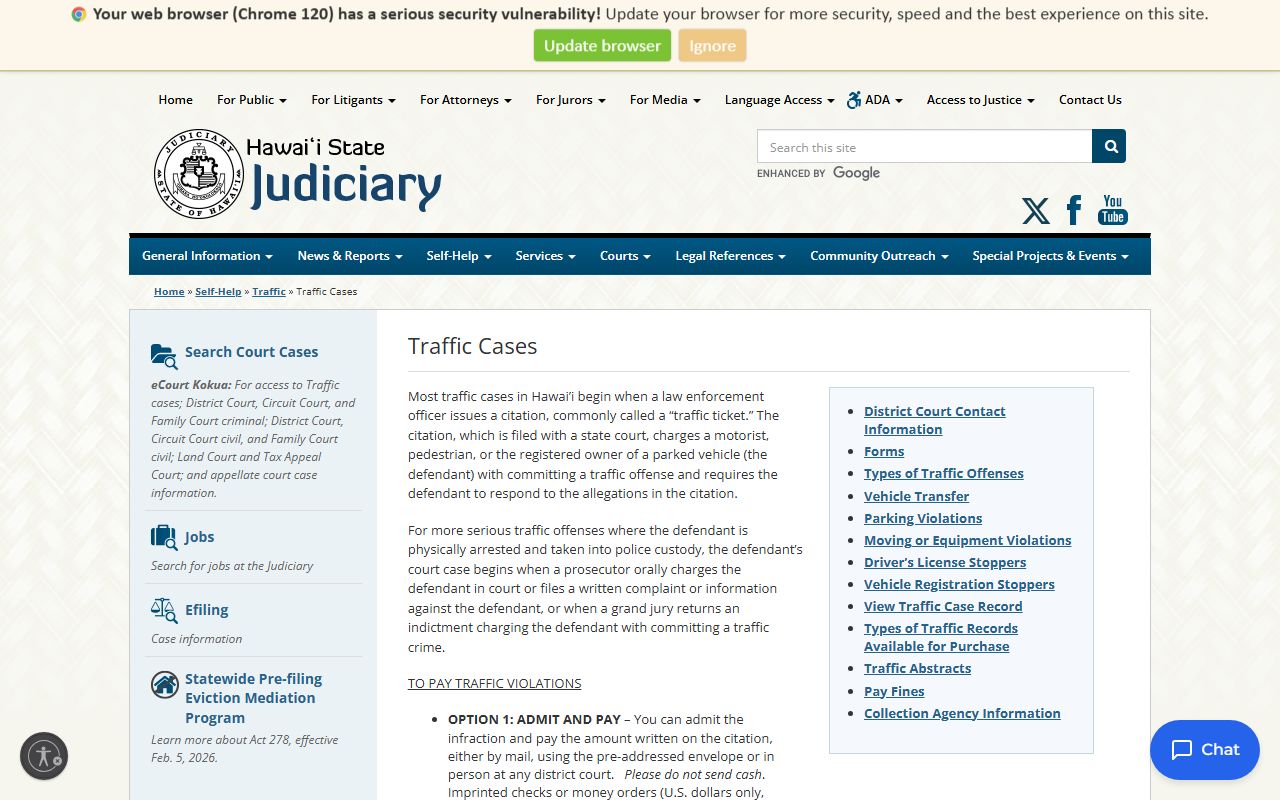
That page covers payment methods, hearing timelines, and contact info for each district court statewide.
How to Pay or Contest a Hawaii Traffic Citation
When you get a traffic ticket in Hawaii, you have 21 calendar days from the citation date to respond. Under HRS Chapter 291D, which governs civil adjudication of traffic infractions, you can admit the violation, deny it and request a hearing, or admit it with an explanation. If you miss the 21-day window without responding, the court can enter a default judgment. That default takes away your right to contest the ticket and may trigger added fees. Section 291D-6 covers your options in detail, and Section 291D-8 covers what happens if you default.
Hawaii gives you four ways to pay. Online payment goes through eTraffic Hawaii, where you enter your citation number and license plate, then pay with Visa, MasterCard, Discover, or American Express. There is a processing fee of $1.50 plus 2.6% of the citation amount. Phone payment is available by calling (800) 679-5949 Monday through Friday using a credit or debit card. Mail payment means sending a check or money order made out to "DISTRICT COURT" in the return envelope that came with your ticket. In-person payment is accepted at any Hawaii district court statewide, where they take cash, check, money order, and card. Most Traffic Violations Bureaus are open Monday through Friday from 8:00 AM to 1:00 PM. The Wailuku court on Maui is open until 4:00 PM. Citations must be paid within 21 days. After that, a $25 fee applies to any returned or dishonored payment.
To fight a ticket, file a denial with the court. A hearing officer reviews your case. If you disagree with the officer's decision, you can request a judge. Under HRS Chapter 291D, you have 30 days to appeal after a judgment is entered.
The Hawaii State Judiciary forms page has all the documents you may need, including motions to continue, motions to set aside a default judgment, change of venue forms, and plea change forms.
These forms are free to download and apply to courts across all circuits in the state.
Traffic Abstracts and Driver History Records
A traffic abstract is a certified document that shows your traffic violation history in Hawaii. It is issued under HRS Section 287-3 and lists all alleged moving violations, convictions, and any administrative license revocations on record. The standard version — sometimes called an abbreviated abstract — does not include parking or equipment citations. To get one, provide your full name along with your date of birth and driver license number when possible. The fee is $20 per abstract, payable by money order or cashier's check only. Personal checks are not accepted. You can request a traffic abstract at any district court statewide, either by visiting in person or mailing a request with a self-addressed stamped envelope. Abstracts serve insurance companies, out-of-state licensing agencies, and anyone who needs a verified record of a driver's history going back multiple years.
The traffic abstracts page on the state judiciary website explains what is included in each type of record and how to submit your request.
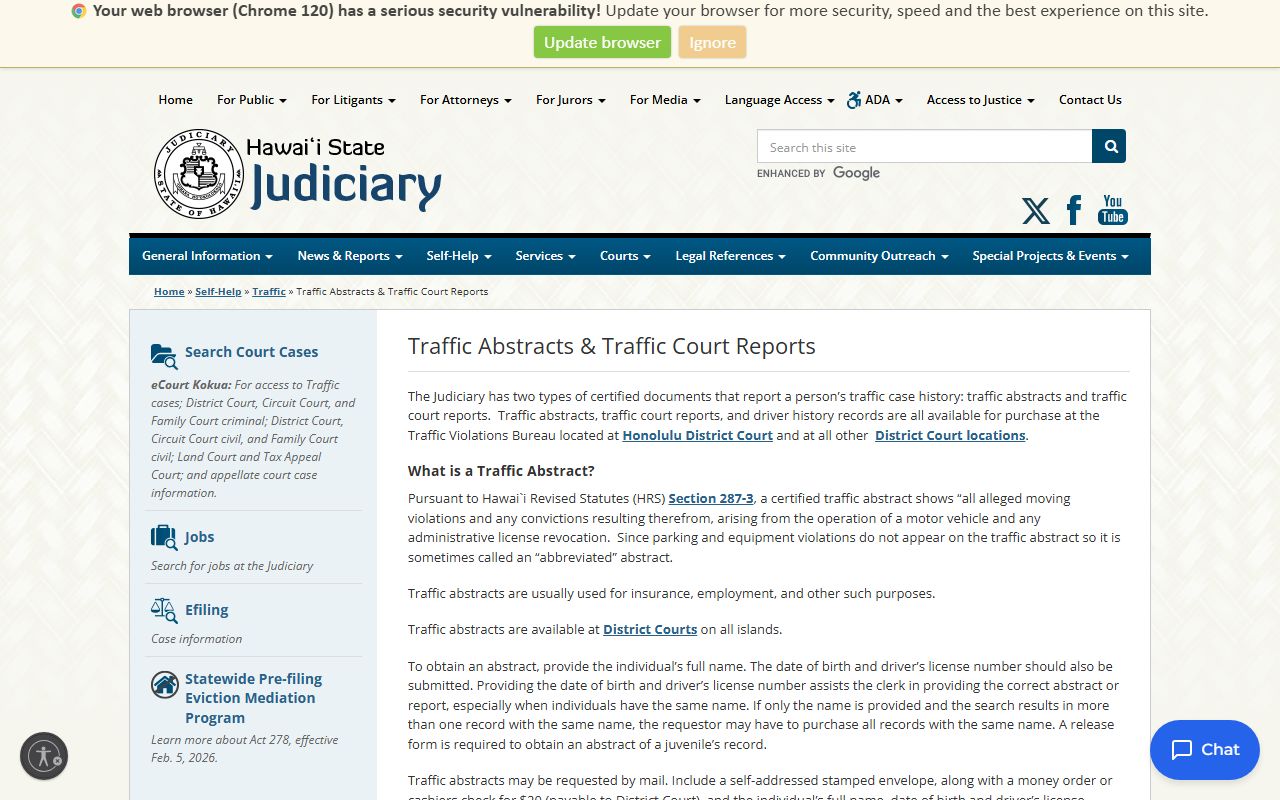
That page also covers traffic court reports, which include parking and equipment violations and are only available in person at a district court.
A traffic court report is a more complete version of the abstract. It covers everything, including equipment and parking citations. You can only get it in person at a district court with a valid photo ID. The fee is $1.00 for the first page and $0.50 for each additional page. This record is not available by mail.
Driver History Records, known as DHRs, are a different product maintained by the Hawaii Department of Transportation. These cost $9 each. A DHR shows preliminary traffic convictions and, for commercial drivers, all CDL disqualifying conviction types. Because DHRs may not reflect overturned court dispositions, the traffic abstract from the district court is more reliable if you need a final record. Contact the HDOT Motor Vehicle Safety Office at (808) 692-7656 for DHR questions.
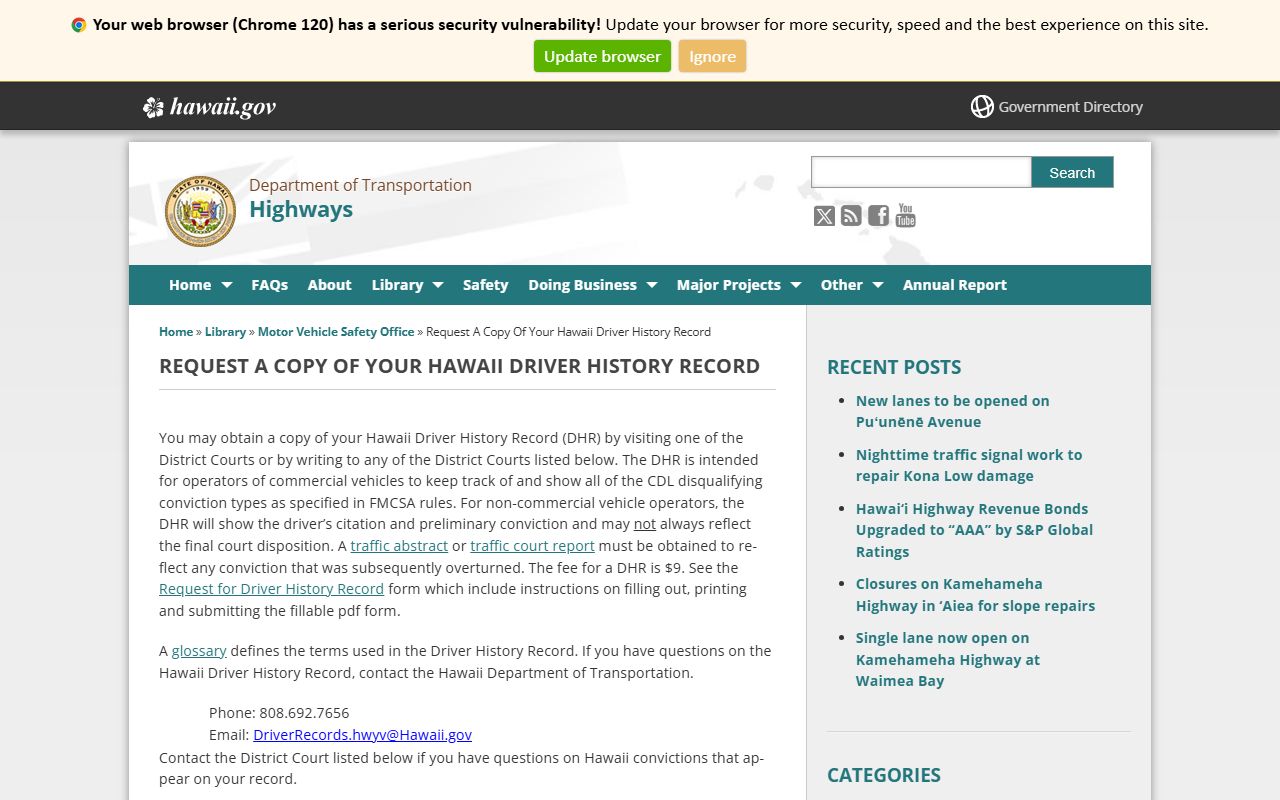
You can request a DHR in person or by written request at any district court statewide, using the Request for Driver History Record form.
Hawaii Traffic Laws and Statutes
Hawaii traffic law is spread across several chapters of the Hawaii Revised Statutes. The core chapter for everyday traffic rules is HRS Chapter 291C, known as the Hawaii Uniform Vehicle Code. It covers speed limits, traffic control devices, right-of-way rules, parking regulations, and equipment requirements. Most common tickets — speeding, running a red light, illegal turns — trace back to a provision in this chapter.
Chapter 291C is the foundation for most moving violation citations issued by police on Hawaii roads.
The chapter that controls how traffic tickets are processed in court is HRS Chapter 291D. This is the civil adjudication law. Key sections include 291D-5 (citation form requirements), 291D-6 (how to answer a citation), 291D-7 (hearing procedures), and 291D-8 (default judgments). If the court enters a default against you for missing the response window, you can file a motion to set it aside under the same chapter. You have 30 days to appeal any adverse judgment under Section 291D-9. Understanding these rules before you respond to a ticket can make a real difference in how your case ends up.
Chapter 291D sets your response timeline, hearing rights, and the full appeal process for all civil traffic citations in Hawaii.
DUI and drug-impaired driving offenses are covered by HRS Chapter 291E. These are criminal offenses, not civil infractions, and they require a court appearance. A DUI conviction can lead to fines, license revocation, required alcohol treatment, and an ignition interlock device requirement governed by HRS Chapter 291J. Administrative license revocations tied to DUI arrests are handled separately by the Administrative Driver's License Revocation Office (ADLRO) at 1001 Bishop Street, Suite 500, Honolulu, reachable at (808) 589-2100.
Chapter 291E governs OVUII and DUI charges, covering penalties and the license revocation process for impaired driving in Hawaii.
Chapter 291J sets the requirements for ignition interlock devices that certain DUI offenders must install as part of their sentence.
Motor vehicle insurance requirements and the authorization for certified traffic abstracts are in HRS Chapter 287. Section 287-3 specifically authorizes the $20 abstract fee and defines what the document must include. Chapter 287 also contains Hawaii's financial responsibility law, which covers minimum insurance requirements for all registered vehicles in the state.
Chapter 287 is the source for traffic abstract authorization and the state's mandatory vehicle insurance requirements.
Public Records Requests for Traffic Documents
Traffic ticket records held by courts are generally public and can be requested by anyone without a stated reason. Police reports and other government agency records fall under the Uniform Information Practices Act (UIPA), codified at HRS Chapter 92F. UIPA is Hawaii's public records law and applies to all state and county agencies. To submit a UIPA request, you must put it in writing. Your request needs to describe the records you are looking for, include your contact information, and state how you want to receive them — by mail, email, or in-person pickup. The agency has 10 business days to respond and may extend that to 20 business days in complex cases. Common exceptions include personal privacy, medical records, and active criminal investigation files.
The Office of Information Practices website has guidance on your rights under UIPA, including how to challenge a denial.
The OIP handles disputes and complaints when agencies deny requests or charge fees you believe are improper. Their office is at 250 South Hotel Street, Suite 107, Honolulu, and can be reached at (808) 586-1400.
Free UIPA model request forms are available on the OIP forms page in both PDF and Word format. Send your completed request directly to the agency that holds the records, not to the OIP.
Police report fees vary by department. The Honolulu Police Department charges $0.50 for the first page and $0.25 per additional page. Maui Police charges $0.25 per page. UIPA search and review time is billed at standard hourly rates for large requests that require significant staff time.
Traffic Violations Bureau Locations in Hawaii
Each judicial circuit in Hawaii has at least one Traffic Violations Bureau, or TVB, where you can pay a citation, request a traffic abstract, or get a Driver History Record. You do not have to go to the court that issued your ticket — any district court statewide can accept payment or handle a records request. Most TVBs operate on a walk-in, first-come, first-served basis during morning hours, Monday through Friday. Bring your citation number and a valid photo ID.
Here are the main TVB locations across the state:
- Honolulu (First Circuit, Oahu): Kauikeaouli Hale, 1111 Alakea Street, (808) 538-5500, Mon-Fri 8:00 AM - 1:00 PM
- Ewa-Pearl City (First Circuit, Oahu): 870 Fourth Street, Pearl City, (808) 534-6900, Mon-Fri 8:00 AM - 1:00 PM
- Kaneohe (First Circuit, Oahu): Abner Paki Hale, 45-939 Pookela Street, (808) 534-6300, Mon-Fri 8:00 AM - 1:00 PM
- Wahiawa (First Circuit, Oahu): 1034 Kilani Avenue, (808) 534-6200, Mon-Fri 8:00 AM - 1:00 PM
- Kapolei/Waianae (First Circuit, Oahu): 4675 Kapolei Parkway, (808) 954-8575, Mon-Fri 8:00 AM - 1:00 PM
- Wailuku (Second Circuit, Maui): Hoapili Hale, 2145 Main Street Suite 137, (808) 244-2800, Mon-Fri 8:00 AM - 4:00 PM
- Hilo (Third Circuit, Hawaii Island): Hale Kaulike, 777 Kilauea Avenue, (808) 961-7470, Mon-Fri 7:45 AM - 3:00 PM
- Kona (Third Circuit, Hawaii Island): 74-5451 Kamakaeha Avenue, (808) 322-8700, Mon-Fri 7:45 AM - 3:00 PM
- Lihue (Fifth Circuit, Kauai): Puuhonua Kaulike Building, 3970 Kaana Street, (808) 482-2355
The district court contact information page on the judiciary website lists current hours and addresses for all courts, including Molokai, Lanai, Hana, and the South Kohala location at Kamuela on Hawaii Island.
Hawaii Criminal Justice Data Center
The Hawaii Criminal Justice Data Center (HCJDC) is operated by the Attorney General's office and serves as the state repository for criminal history records, including criminal traffic offenses. The HCJDC runs the eCrim portal, an online tool that lets you conduct name-based criminal history searches. A basic eCrim search costs $5 per name, and a full eCrim report runs $10. Results show conviction information only — not arrests, dismissed cases, or civil infractions. Fingerprint-based background checks are also available through the HCJDC for more thorough record searches. The office is at 465 South King Street, Room 101, Honolulu, and can be reached at (808) 587-3100.
The HCJDC website has links to the eCrim portal, sex offender registry information, and instructions for fingerprint-based searches.
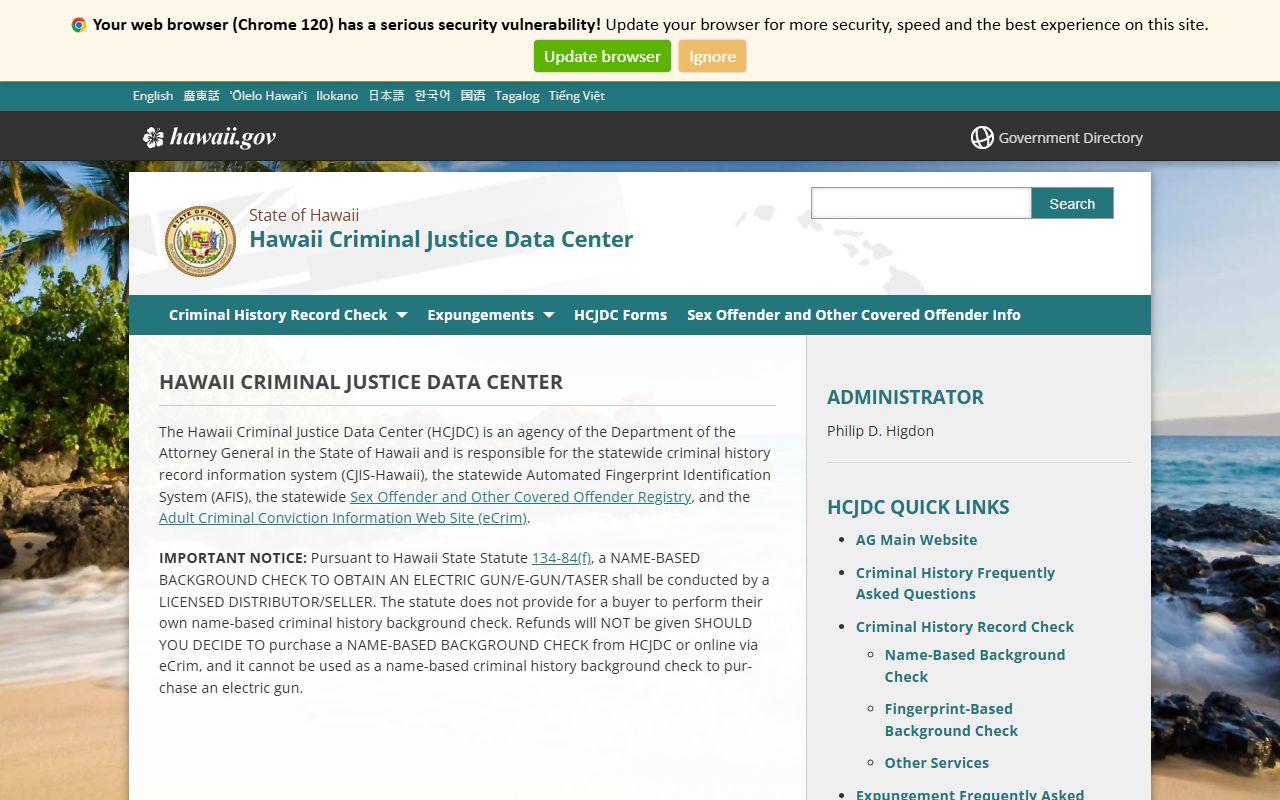
Note: eCrim covers criminal traffic convictions only. For a full traffic history including civil infractions like speeding and red light violations, request a traffic abstract from any district court.
License Stoppers, Act 59, and Legal Help in Hawaii
Hawaii passed Act 59 in 2020, also known as House Bill 2750, which changed how unpaid traffic citations affect driver's licenses and vehicle registrations. Under Act 59, parking tickets and routine civil traffic citations issued after November 2020 no longer generate automatic license or registration stoppers. Before this change, missing a fine payment could block your registration renewal even for minor violations. Fines can still go to collections and citations still need to be resolved, but the automatic stopper mechanism for civil infractions no longer applies. Act 59 does not cover DUIs, reckless driving, or other criminal traffic offenses, which continue to carry the full range of license consequences under existing law.
If you have a stopper from before November 2020, you may be able to petition to have it removed. Volunteer Legal Services Hawaii helps people with stopper petitions, converting fines to community service, and understanding what is on their traffic abstract. VLSH has free forms and FAQ guides on their website. Their services are available to low-income Hawaii residents who need help navigating the citation process and getting their driving privileges restored.
For court records requests across all Hawaii circuits, the Hawaii State Judiciary court records request page has instructions and forms for requesting copies of case files from any circuit in the state.
Browse Hawaii Traffic Records by County
Hawaii has four main counties and the unique Kalawao County, each served by its own circuit court system. Select a county below to find district court contact details, police department information, and local resources for traffic ticket records in that area.
Traffic Ticket Records in Major Hawaii Cities
Residents of major Hawaii cities handle traffic citations through the district court serving their area. Select a city below to find local court contact info, police department details, and guidance on accessing traffic ticket records near you.