
Maui County Traffic Ticket Records
Maui County traffic ticket records are kept by the Second Circuit courts and the Maui Police Department, covering the islands of Maui, Lanai, and Molokai. This guide explains how to find, request, and review traffic ticket records from the right office, whether you need a court case summary, a citation copy, or a full driver history report.
Maui County Overview
Second Circuit Courts in Maui County
The Second Circuit handles all traffic cases across Maui, Lanai, and Molokai. There are five district court locations, each serving different parts of the county. The main hub is in Wailuku. The others are smaller courts that handle local cases but often route paperwork back to Wailuku for filing and records.
Wailuku District Court is the primary court for traffic matters. It sits inside Hoapili Hale at 2145 Main Street, Suite 137, Wailuku, HI 96793. The Traffic Violations Bureau is located here. Call (808) 244-2800 if you need to confirm a hearing date, check a fine amount, or ask about your case status. Hours run Monday through Friday, 8:00 AM to 4:00 PM. The Legal Documents Branch for the Second Circuit is also in this building, reachable at (808) 244-2969.
Lahaina District Court is at 1870 Honoapiilani Hwy, Lahaina, HI 96761, phone (808) 661-0970. Hana District Court shares the same Lahaina mailing address and phone but is physically located at 4974 Uakea Road, Hana, HI 96713. Lanai District Court is at 312 Eighth Street, Lanai City, phone (808) 565-6447. Molokai District Court operates out of 55 Makaena Street, Kaunakakai, phone (808) 553-1100. These courts handle local hearings, but records requests for all five locations typically go through Wailuku.
| Court | Phone |
|---|---|
| Wailuku District Court (main) | (808) 244-2800 |
| Lahaina District Court | (808) 661-0970 |
| Hana District Court | (808) 661-0970 |
| Lanai District Court | (808) 565-6447 |
| Molokai District Court | (808) 553-1100 |
How Traffic Citations Work in Maui County
When a driver gets a traffic ticket in Maui County, that citation falls under Hawaii Revised Statutes Chapter 291D. This chapter governs traffic infractions across the state. It covers the notice process, payment rules, and what happens if you miss a deadline. Most tickets issued on Maui are civil infractions under this chapter, not criminal charges.
Once you get a ticket, you have 21 days to respond. You can pay the fine, request a hearing, or contest the infraction in writing. If you do nothing within 21 days, the court can enter a default judgment against you. That adds costs and can affect your license. The eTraffic Hawaii system lets you pay traffic fines online or by phone without going to the courthouse. It covers most standard infractions issued in Maui County. If your ticket is not eligible for online payment, the Wailuku Traffic Violations Bureau can help you figure out your options.
Moving violations fall under HRS Chapter 291C, which is the main traffic code for Hawaii. Speeding, unsafe lane changes, and other road safety violations are defined here. Serious violations can lead to criminal charges rather than simple fines. In those cases, you would appear before a judge rather than just paying through eTraffic. The Hawaii Judiciary traffic cases page explains the difference between infractions and criminal traffic offenses.
Note: If your ticket says "criminal" rather than "infraction" on the citation, you should contact an attorney before responding to the court.
Search Maui Traffic Records Online
The main tool for searching Maui County traffic ticket records online is eCourt Kokua, the Hawaii Judiciary's public case search system. You can look up cases by name, case number, or citation number. The system shows case status, hearing dates, court orders, and fine amounts. It covers all circuit and district court cases statewide, including Second Circuit cases from Maui, Lanai, and Molokai.
eCourt Kokua is free to use and does not need an account. Just enter the name or case number and the system returns matching records. Keep in mind that some older cases may not be fully digitized. If you can't find a record online, that doesn't always mean it doesn't exist. You may need to contact the Legal Documents Branch at (808) 244-2969 to check physical files.
The Hawaii Judiciary district court contact page lists all Second Circuit locations and direct phone numbers for each court.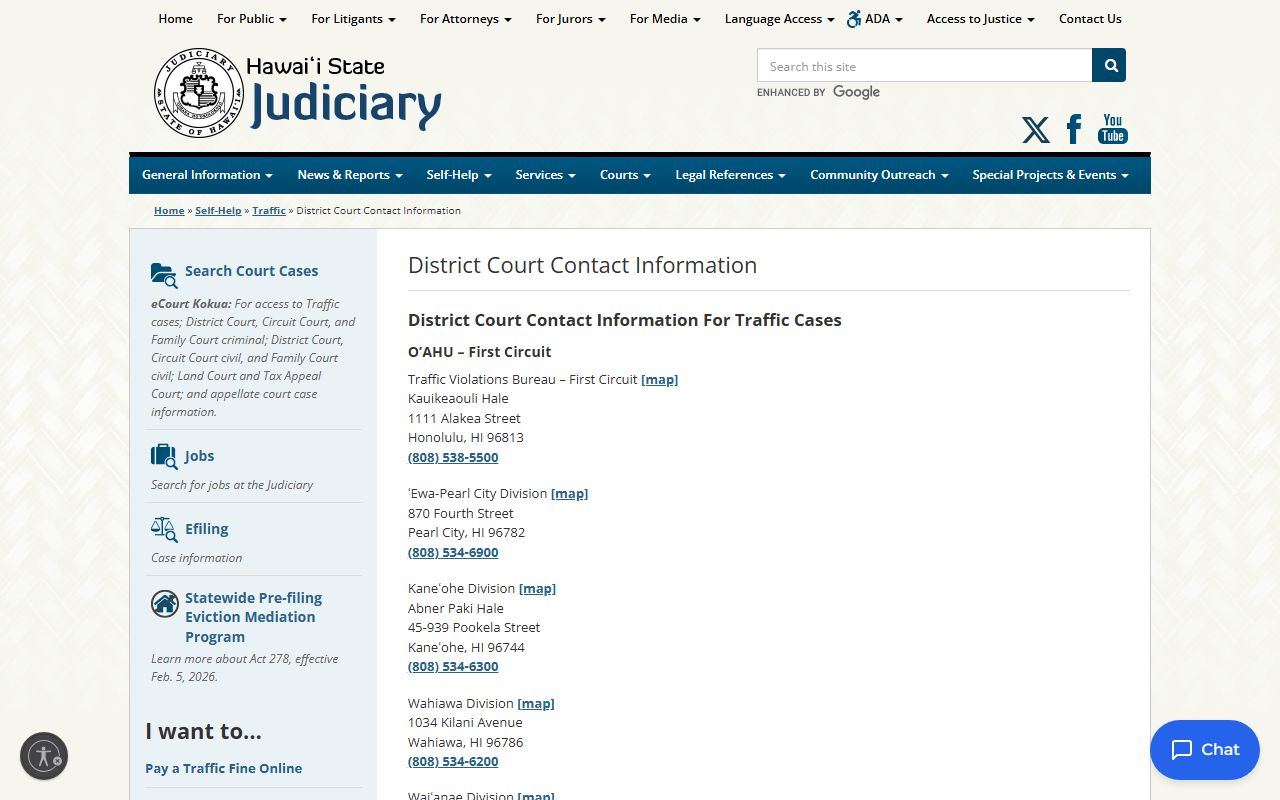
The district court contact page is the best place to confirm current hours and addresses for any of the five Second Circuit court locations serving Maui County.
Traffic Abstracts and Driver History Records
A traffic abstract is a certified court document that lists your traffic case history in Hawaii. It shows ticket dates, violation types, fines, and case outcomes. Many employers, insurers, and licensing boards ask for this document. The Hawaii Judiciary charges $20 per traffic abstract. You can request one through the court's traffic abstract page. Requests can be submitted in person or by mail to the Legal Documents Branch in Wailuku.
The driver history record (DHR) is a different document. It comes from the Hawaii Department of Transportation, not the courts. A DHR shows your license status, point totals, and driving record as kept by the state motor vehicle safety office. The fee is $9. You can request yours through the HIDOT motor vehicle safety office. The DHR and the traffic abstract cover overlapping information, but they are not the same thing. Courts track case outcomes. HIDOT tracks your license points and driving status. Some purposes require both.
Note: A certified abstract from the court carries more legal weight than a printout from eCourt Kokua, which is a public reference tool only.
Maui Police Department Records Requests
The Maui Police Department website provides contact details and links to records request procedures for traffic-related police reports.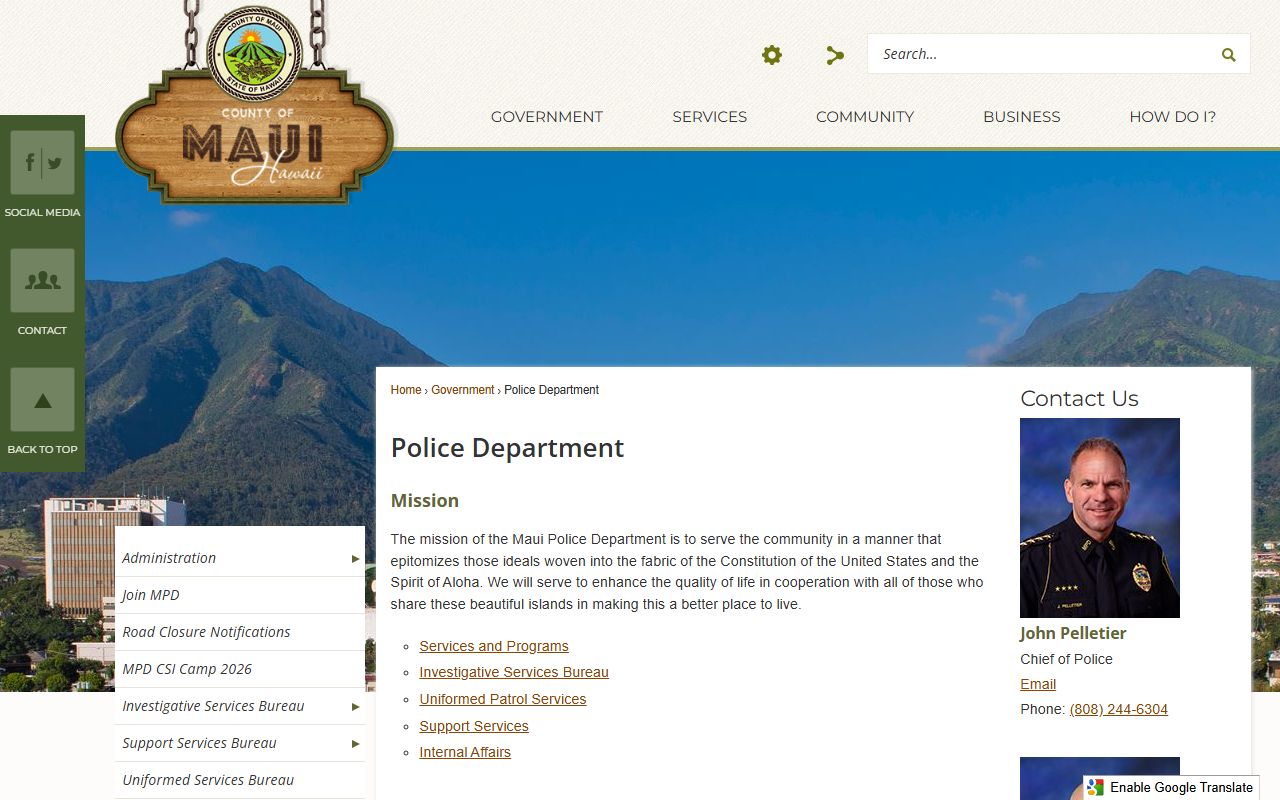
The Maui Police Department Records Section handles requests for police reports tied to traffic incidents, accidents, and citations issued anywhere in Maui County.
The Maui Police Department Records Section handles requests for police reports tied to traffic incidents, accidents, and citations. The office is at 55 Mahalani Street, Wailuku, HI 96793. Call (808) 244-6355 to reach the records desk. Fax is (808) 244-6418. Hours are Monday through Thursday, 8:00 AM to 4:00 PM. For questions about the content of a specific report, call (808) 244-6400 and ask to be connected.
Police report copies cost $0.25 per page. You can pick them up in person or request them through the county's online portal. Reports tied to accidents or serious traffic stops are often needed for insurance claims, legal proceedings, or license hearings. If you were involved in a crash on Maui, the responding officer would have filed an incident report with the Maui Police Department. That report is separate from any court case that may follow.
Maui County UIPA Records Portal
The Maui County public records request page outlines the UIPA process and links to the GovQA submission portal.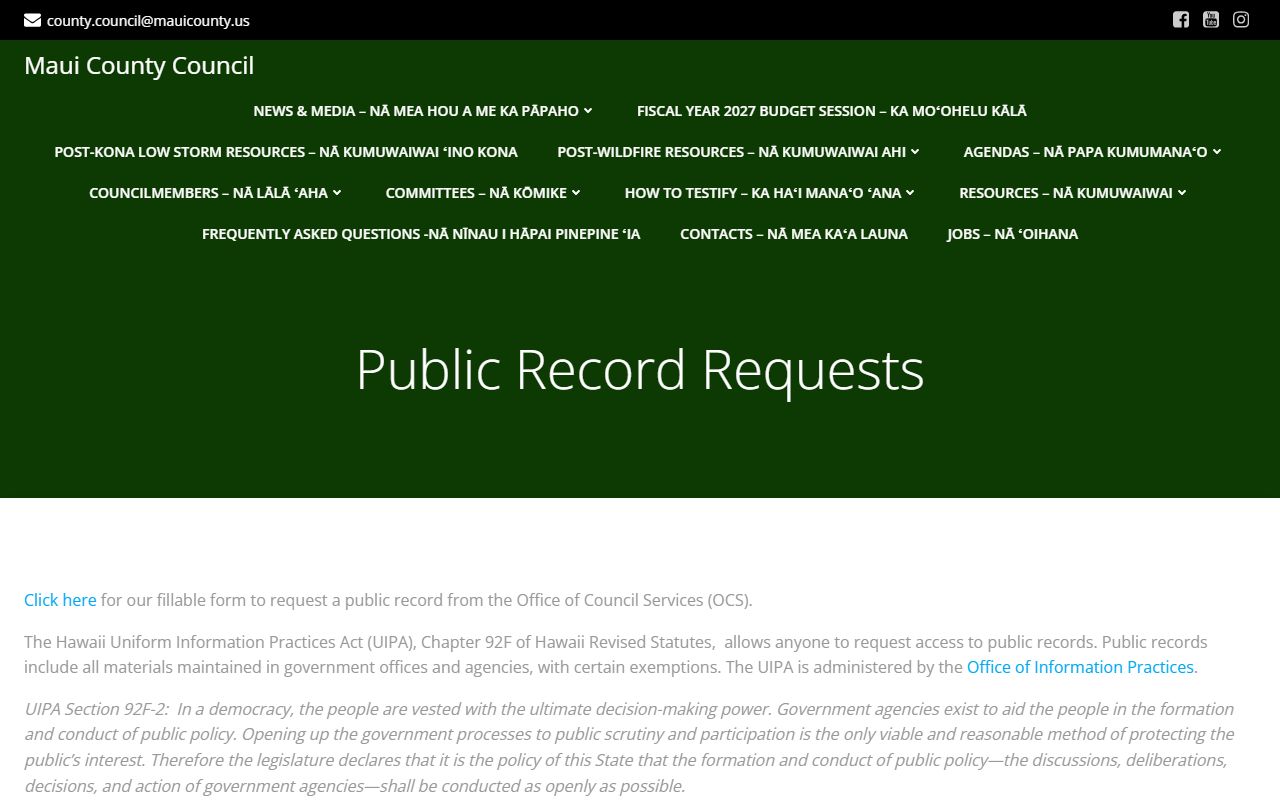
The Maui County public records request page outlines the UIPA process and links to the GovQA submission portal for online requests.
Hawaii's Uniform Information Practices Act (UIPA) gives the public the right to request government records, including records held by county agencies. The Office of Information Practices oversees how agencies comply with UIPA statewide. In Maui County, you can submit UIPA requests through the Office of Council Services, which coordinates public records requests. Call (808) 270-7838 or email ocs.request@mauicounty.us to start a request. Response time is 10 business days, though complex cases can take up to 20.
In January 2024, Maui County launched a new online UIPA portal through GovQA. You can access it at mauicountyhi.govqa.us. The portal lets you submit and track requests online. To use it, create a free account, fill out the request form, attach any supporting documents, and submit. Departments available on the portal include the Maui Police Department, Fire Department, MEMA, Mayor's Office, Planning, Public Works, Corporation Counsel, and the Water Supply division.
The Maui County GovQA portal allows online submission and status tracking for all public records requests, including those directed to the Maui Police Department.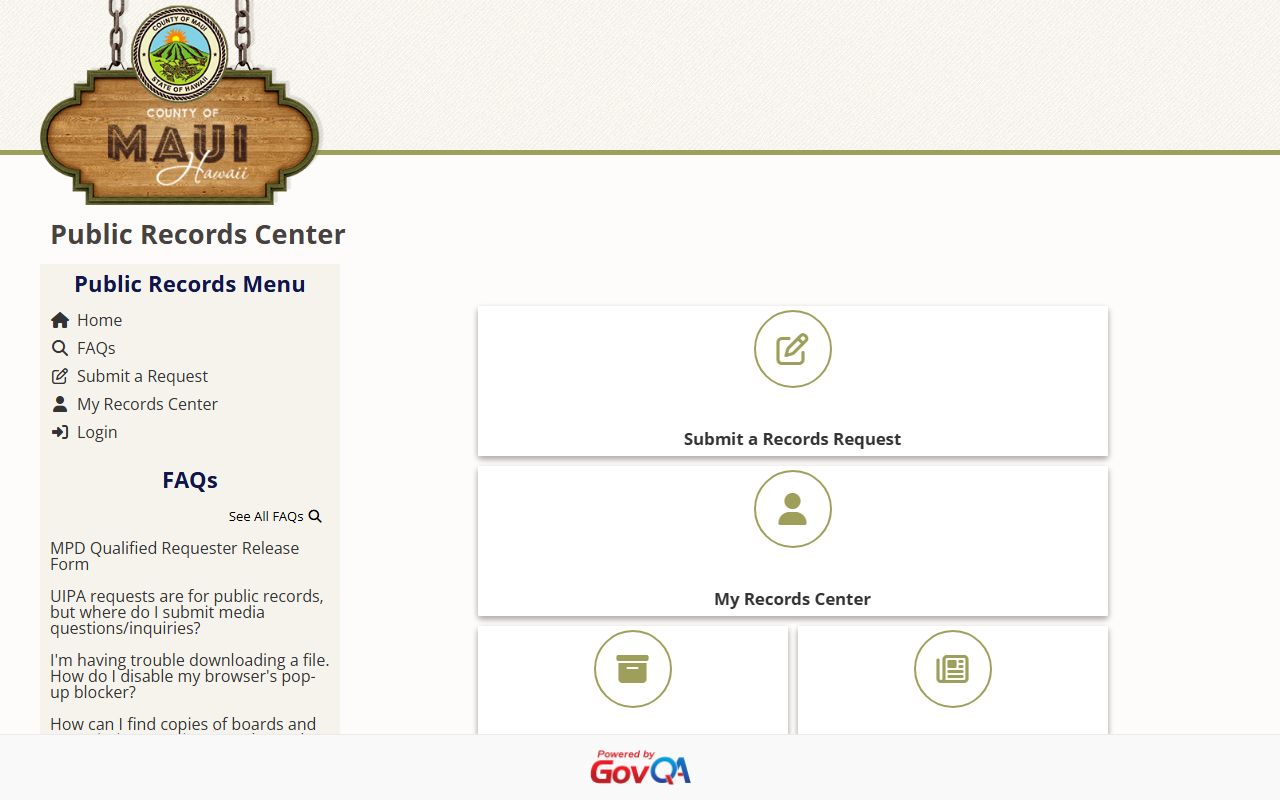
The Maui County GovQA portal allows online submission and status tracking for all public records requests, including those directed to the Maui Police Department.
The UIPA portal is the best option for requesting police records tied to traffic cases handled by county agencies. Court records, on the other hand, go through the Hawaii Judiciary system, not the county portal. Keep this in mind when deciding where to send your request. If you are not sure which agency holds the record you need, the Office of Council Services can point you in the right direction.
Note: Not all records are releasable under UIPA. Some reports involving minors or ongoing investigations may be withheld or partially redacted.
Legal Help and Self-Help Resources
The Hawaii Judiciary maintains a court forms library on its website. You can find forms for contesting a ticket, requesting a hearing, or asking for a payment plan. These forms are free to download. The Volunteer Legal Services Hawaii provides free legal help to qualifying residents, which can include advice on traffic cases that have turned into more serious legal matters.
If you are not sure how to handle your ticket, the Traffic Violations Bureau at Wailuku is often the best first call. They can tell you what options are open, whether your case is still active, and what paperwork you need. That's true for residents and visitors alike. Many traffic tickets in Maui County involve tourists who are no longer on the island when a hearing is scheduled. The eTraffic system and online court search tools exist partly to help people deal with cases from a distance.
Cities in Maui County
The following cities in Maui County have their own traffic ticket records pages with local court and police department details.
Nearby Counties
Traffic ticket records for other Hawaii counties are available through their respective circuit court systems and county agencies.